
A guide by Rabenring · stage textiles since 1992
Theatre Curtain Guide: Fabrics, Fire Safety and Care
Which fabric for the house curtain, what the fire rules ask for, and how do you clean velvet without washing out the flame retardant? Straight answers for theatres, concert halls, cinemas and school stages.
Photo: La Scala ©wulfman65 / depositphotos.com
Where to start
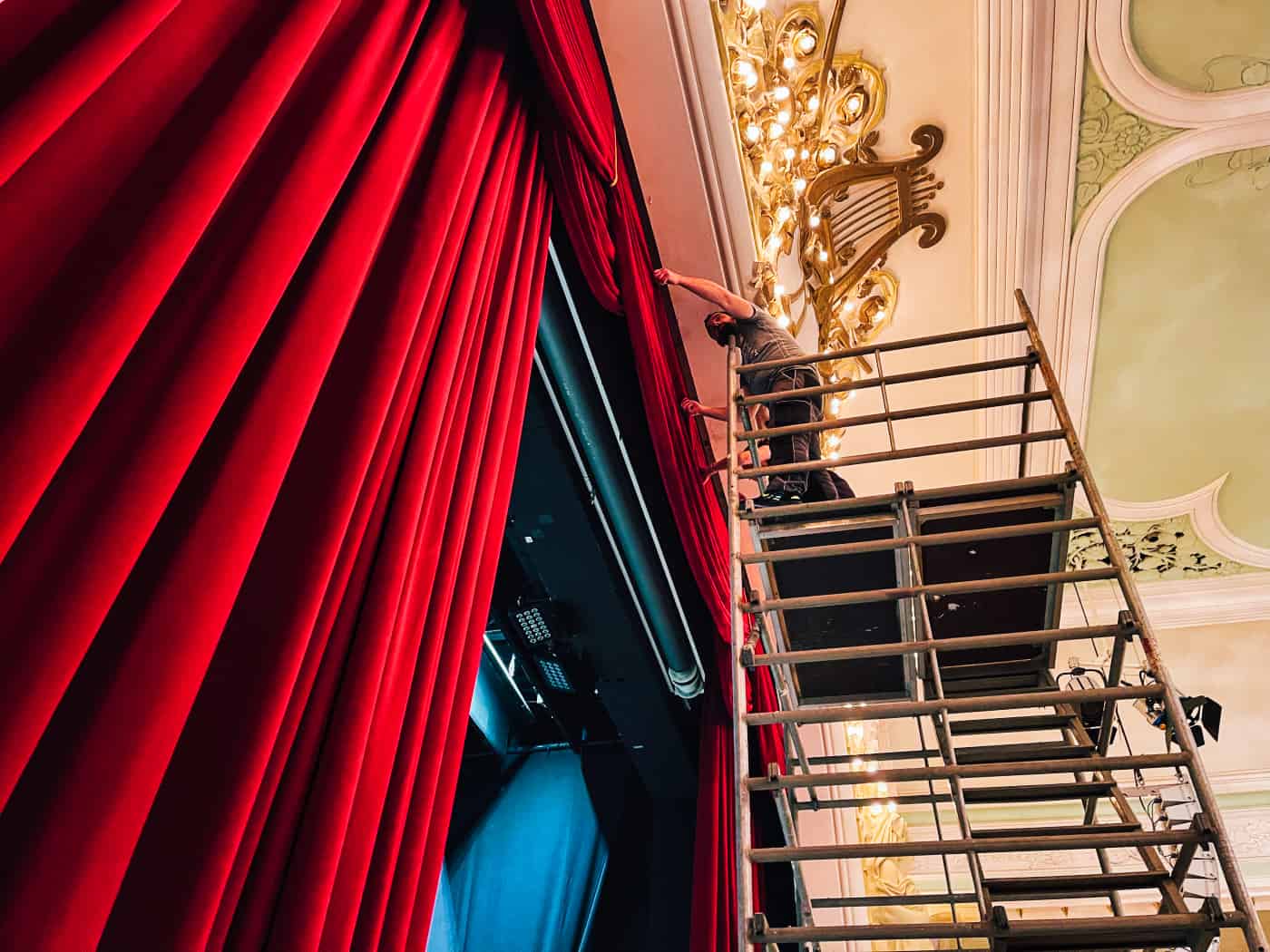 Velvet curtainsCotton velvet or Trevira CS, kalmuk or molton: which fabric suits your stage.Read the guide →
 Cleaning curtainsDry clean or wash? How to keep velvet and fire protection intact.Read the guide →
 Safety curtainWhich stages need an iron curtain, what the rules demand and where it came from.Read the guide →
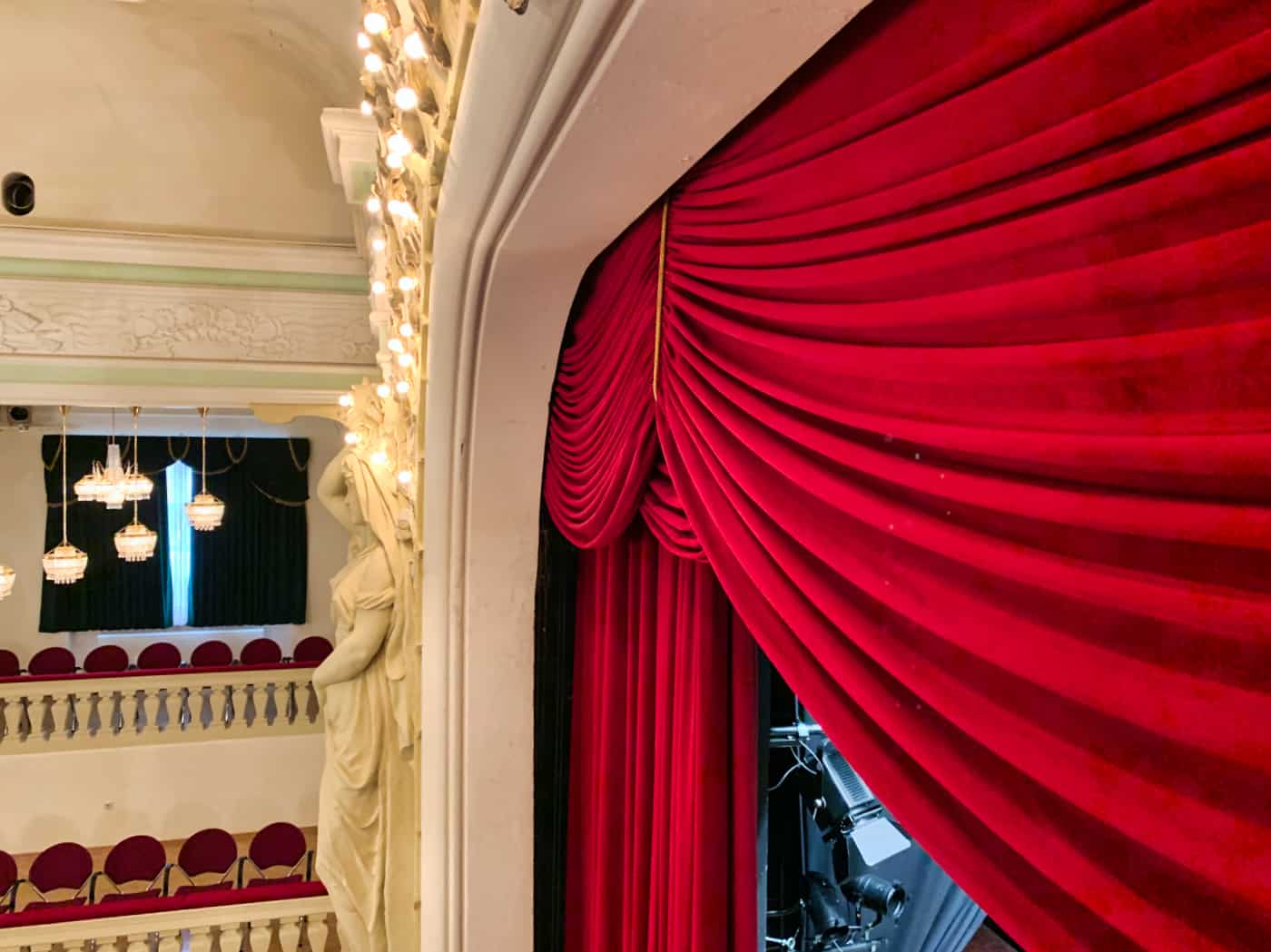 Made to measureHouse curtains, legs and borders from the Rabenring workshop near Dresden.Advice and ordering →
What is a theatre curtain?
A theatre curtain separates the stage from the auditorium. It opens at the start of a show, closes for the interval and brings the cast back for applause at the end. It also does real technical work: it blocks light, absorbs sound and has to be safe if a fire breaks out. You will find one on stages of every size, in opera houses and concert halls, in cinemas and anywhere a room needs its acoustics calmed down.
Rabenring makes theatre curtains for large houses as well as for amateur theatres, school halls, concert venues and cinemas. Every curtain is made from flame retardant fabric. On request the workshop also makes acoustic and sound insulating curtains from molton and other fabrics.
Types of theatre curtain
Stage people sort curtains by the way they open. Four basic forms have become standard: the curtain is split and drawn aside, gathered up diagonally, flown straight up, or lifted and gathered at the same time. Which one works for you depends on the height of the stage, the space above the proscenium opening and the effect you want.
Hardware: track, bar and drive
How a curtain moves depends on how it hangs. A traveller runs on gliders or carriers in a curtain track fixed to the ceiling or a truss above the opening. A fly curtain hangs from a bar that is raised on lines. Tableau and festoon curtains are moved by cords that run through rings on the back of the fabric.
Curtains are worked by hand with a rope line or by motor. A motor pays off for large, heavy curtains, for daily use and wherever the curtain is operated from the control room. Small stages in schools and community halls usually manage fine with a hand line.
Other curtains on stage
A bigger stage needs more than the house curtain. Legs frame the opening left and right, borders hide lights and rigging overhead. Molton masking forms the wings that performers use to come and go. At the back hangs a black drop or a cyclorama. Large stages also have a safety curtain for fire protection.
A short history of the theatre curtain
The theatre of ancient Greece had no curtain at all. It appeared in Roman theatre around the middle of the first century BC. The medieval multiple stage worked without a main curtain and used several smaller ones to hide and reveal single scenes instead. The house curtain as we know it has been used on opera and ballet stages since the 16th century.
East Asia went its own way. Japanese kabuki uses a main curtain alongside act curtains, scene change curtains, back curtains and reveal curtains.
The curtain call as a measure of applause
Since the 19th century the curtain has been the yardstick of success. If the audience keeps clapping, the curtain opens again and the cast steps forward once more. Each of these returns is a curtain call. In 1988 Luciano Pavarotti set the record at the Deutsche Oper Berlin in Donizetti’s L’elisir d’amore: 165 curtain calls in 67 minutes.

Why are theatre curtains red?
The colour is usually traced back to court theatre. Red stood for royalty, and when a play was staged at court, the curtain was red. The habit stuck. Today many houses choose a colour that matches their auditorium instead, from bordeaux and royal blue to slate grey.
What is a safety curtain?
Large theatres have a second curtain in front of the house curtain, made of non combustible material. In a fire it seals the stage off from the auditorium. It became standard in Europe after the Ringtheater fire in Vienna in 1881, and the political term „Iron Curtain“ was borrowed from it. Which stages need one and what German rules require is covered in our guide to the safety curtain.
Velvet, molton or kalmuk
Most theatre and acoustic curtains are made from velvet, heavy molton or kalmuk. For extra sound insulation, a plastic membrane is sometimes sewn in between several layers of fabric.
Velvet
Velvet is the classic house curtain fabric. It has an upright pile, which makes it dense and heavy: it swallows light and hangs calmly. Stage velvet comes in cotton and in inherently flame retardant polyester (Trevira CS). Cotton has the traditional look, Trevira CS can be washed and lasts longer in busy halls. The differences and the right amount of fullness are explained in our guide to velvet stage curtains.
Molton

Standard colours of stage molton
Molton came later as a much cheaper alternative to velvet. It is a cotton fabric brushed on both sides. Treated to DIN 4102 B1 it is flame retardant, and its rough surface absorbs sound while its weight blocks light. Lighter grades up to about 190 g/m² are woven in plain weave; heavier stage molton from 250 g/m² uses a twill weave.
Kalmuk
Kalmuk is a cotton double cloth with a very bulky backing yarn. It is woven in twill and brushed on both sides, so the weave is no longer visible. Tradition says the name comes from the Kalmyks, a Mongolian nomad people who used the cloth for saddle blankets. That story is not documented.
Can theatre curtains be cleaned?
Yes, with care. Cotton curtains such as velvet, molton and kalmuk should only be cleaned dry, by vacuuming or brushing. Water strips out the flame retardant finish and shrinks the cotton. Trevira CS and FR polyester stay flame retardant for life and may be washed according to the care label. Large curtains are usually cleaned by a specialist firm. Details are in our guide to cleaning theatre curtains.
Sound and heat
Heavy theatre and acoustic curtains do more than dampen sound. Because the fabric is much thicker than ordinary curtains, they also insulate: they keep cold out in winter and heat out in summer. For small theatres and school productions, molton can even be printed with a design, so one curtain handles acoustics, blackout and decoration.
Samples and prices
Most makers send fabric and colour samples. Look at them under light similar to your hall, because velvet changes colour noticeably with the angle of light. Rabenring sends sample cards for stage velvet and stage molton free of charge.
Price depends on what the curtain has to do. A purely decorative curtain is inexpensive. Once sound absorption, insulation and fire protection matter, a specialist maker is worth it. Curtains are sold by the metre or made to measure. The fabric, the size of the opening and the fullness decide the price.
Reference: the Neue Welt concert and ballroom in Zwickau
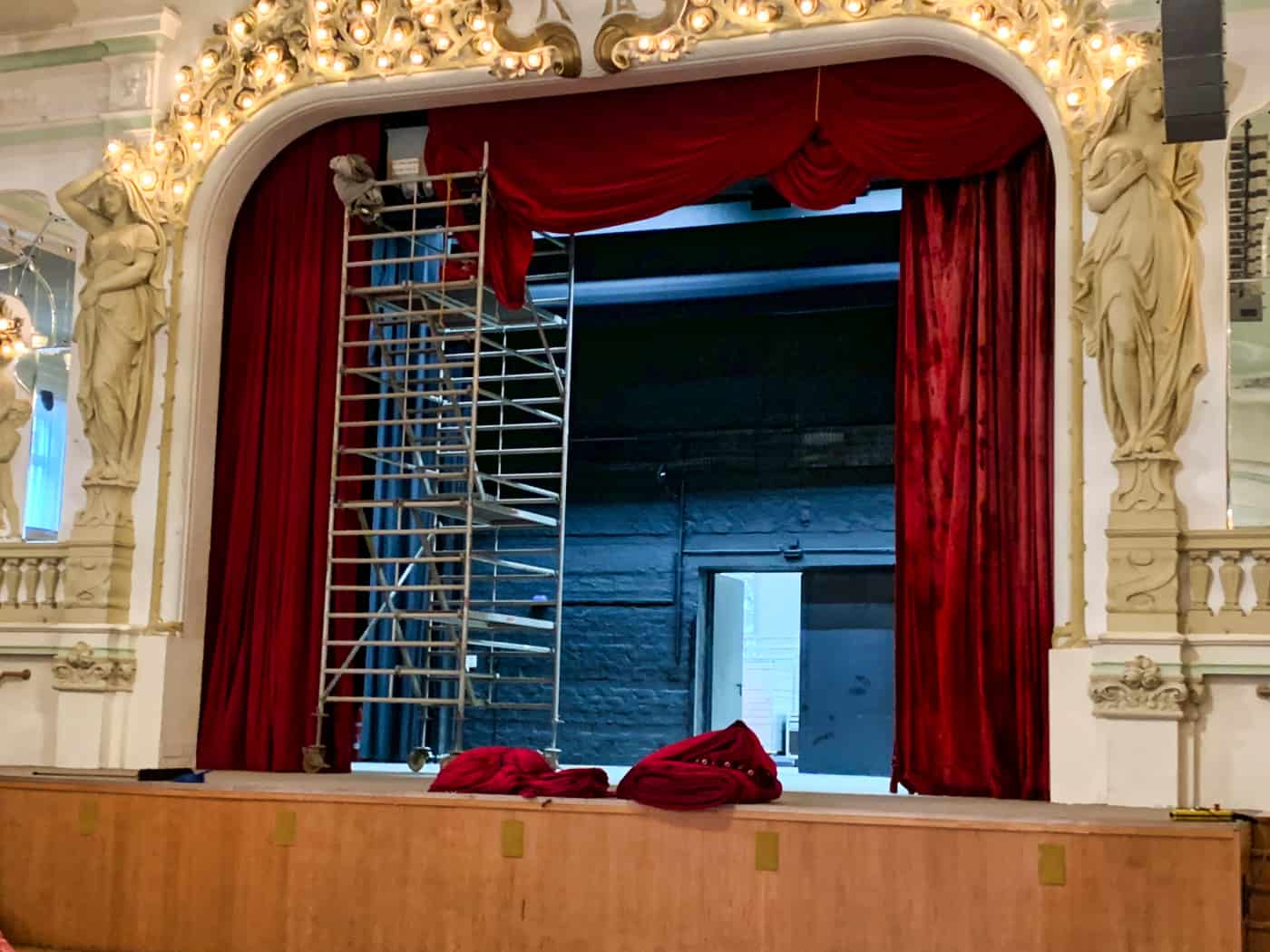
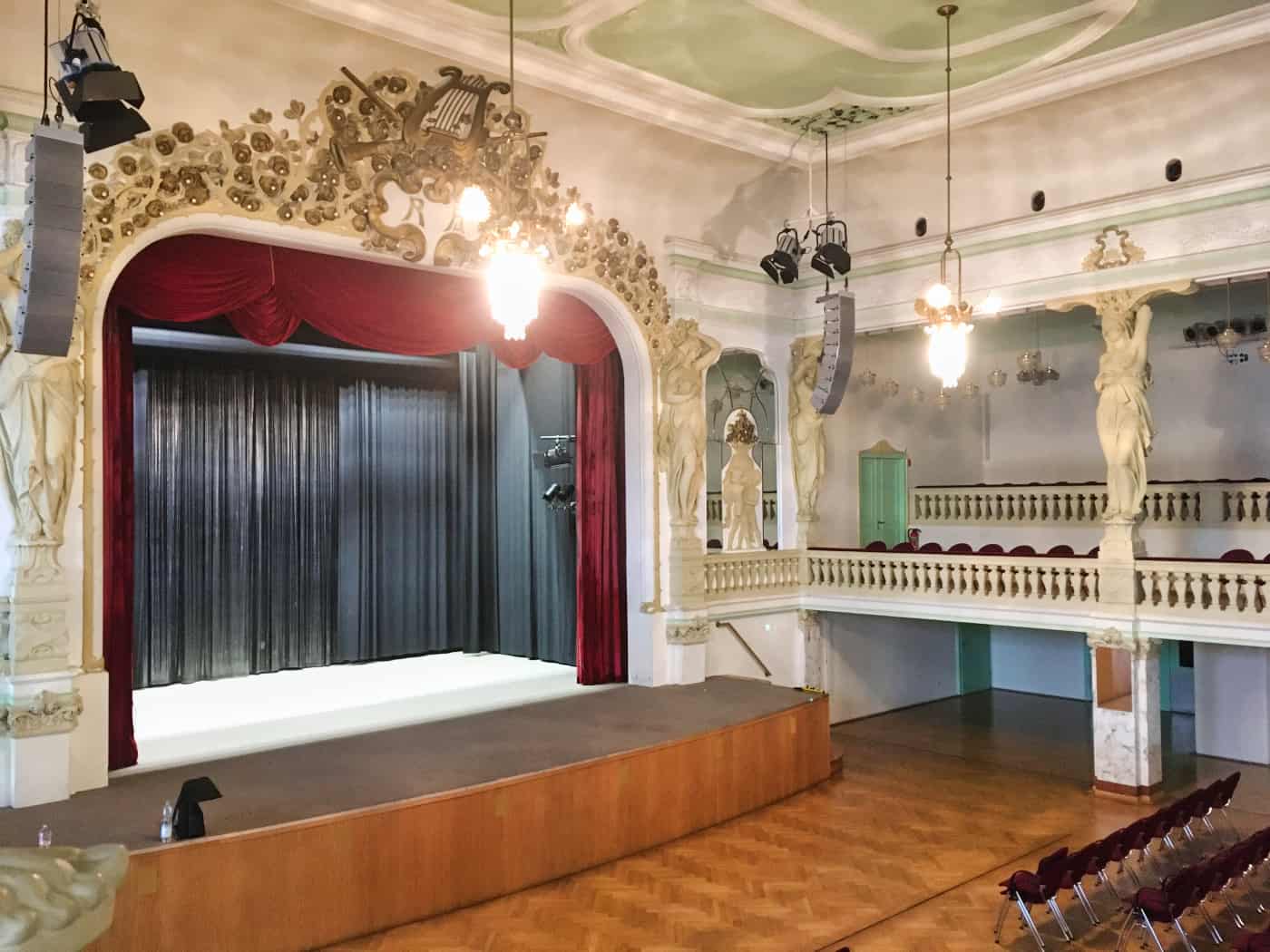
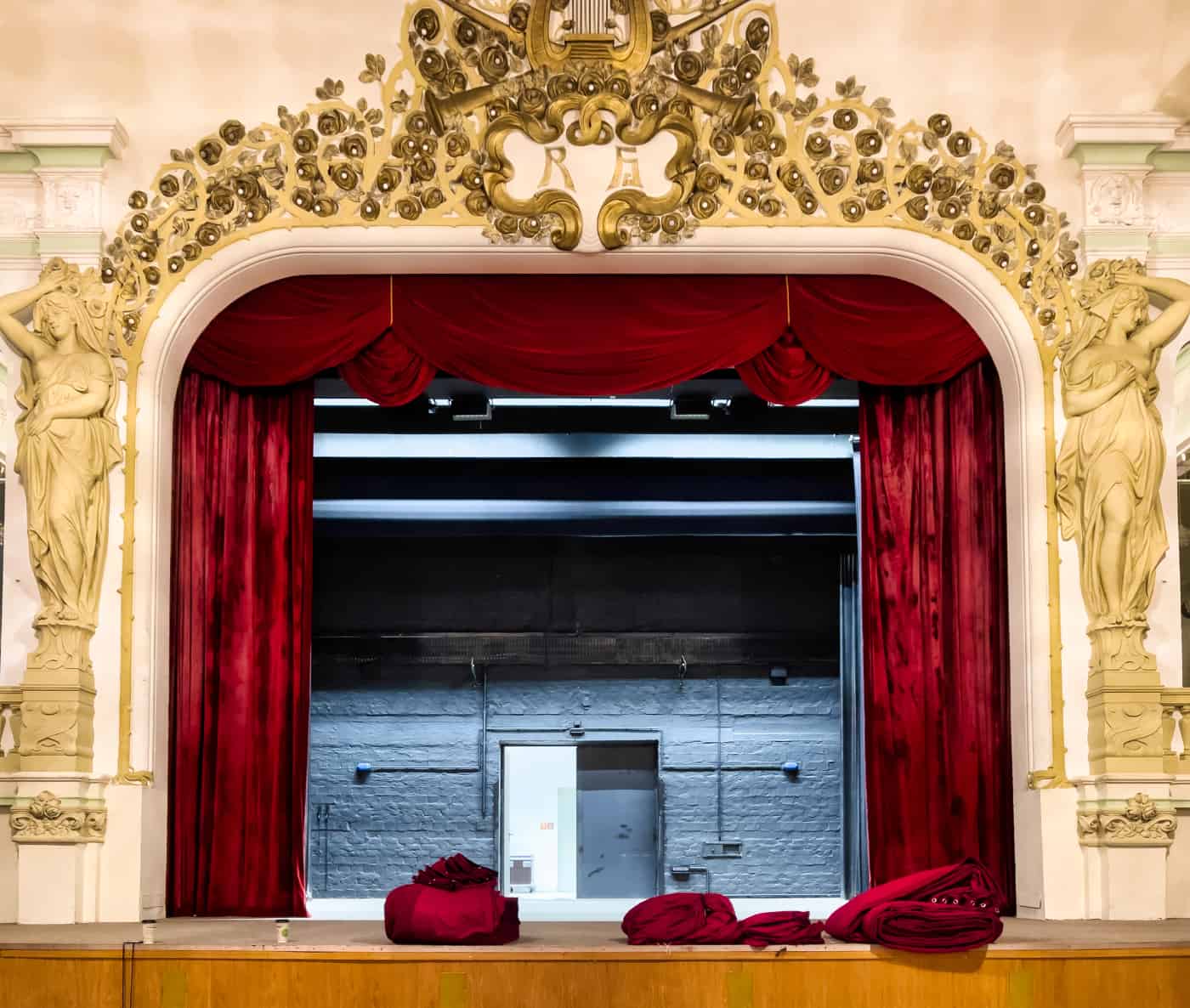
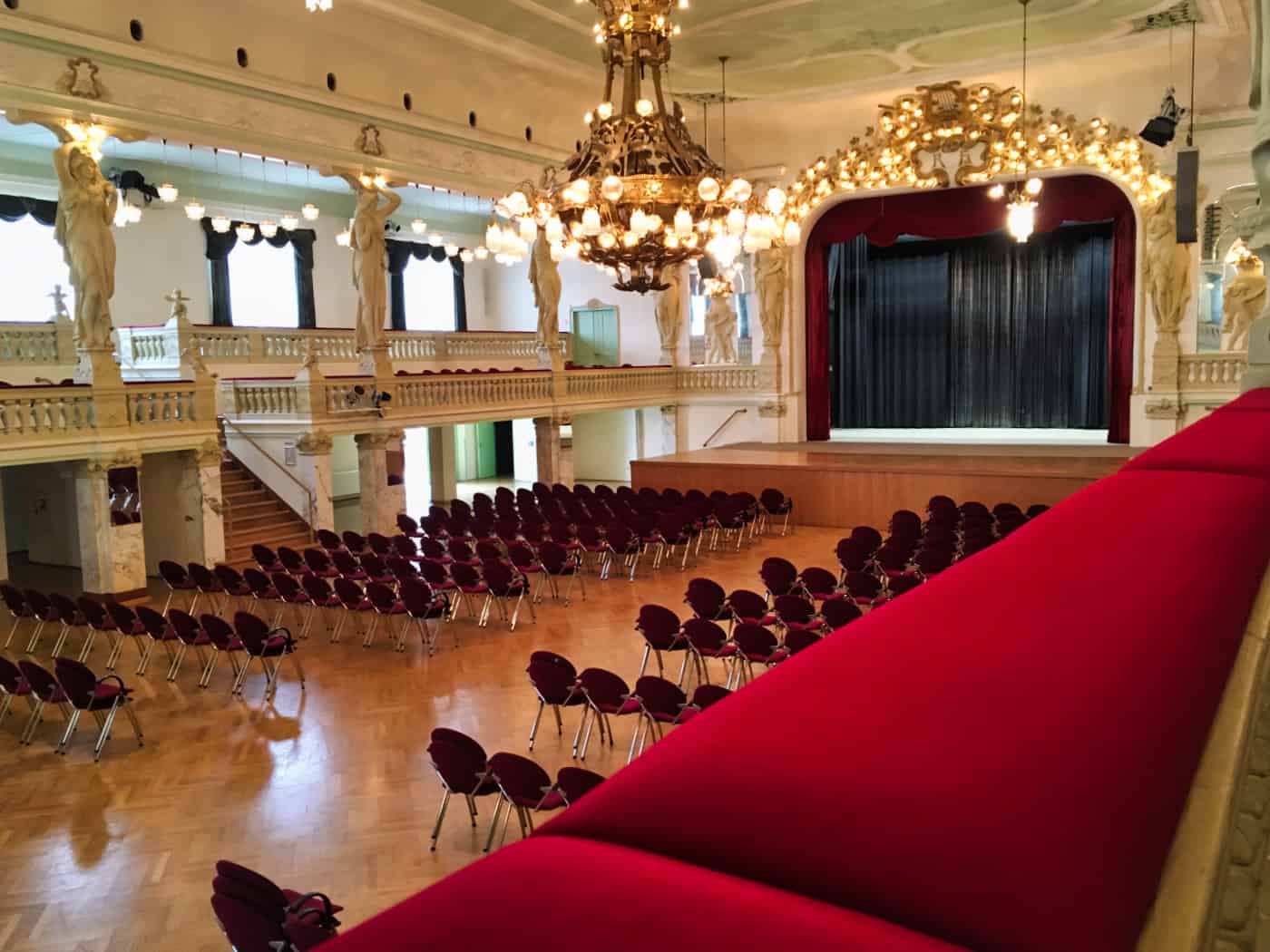
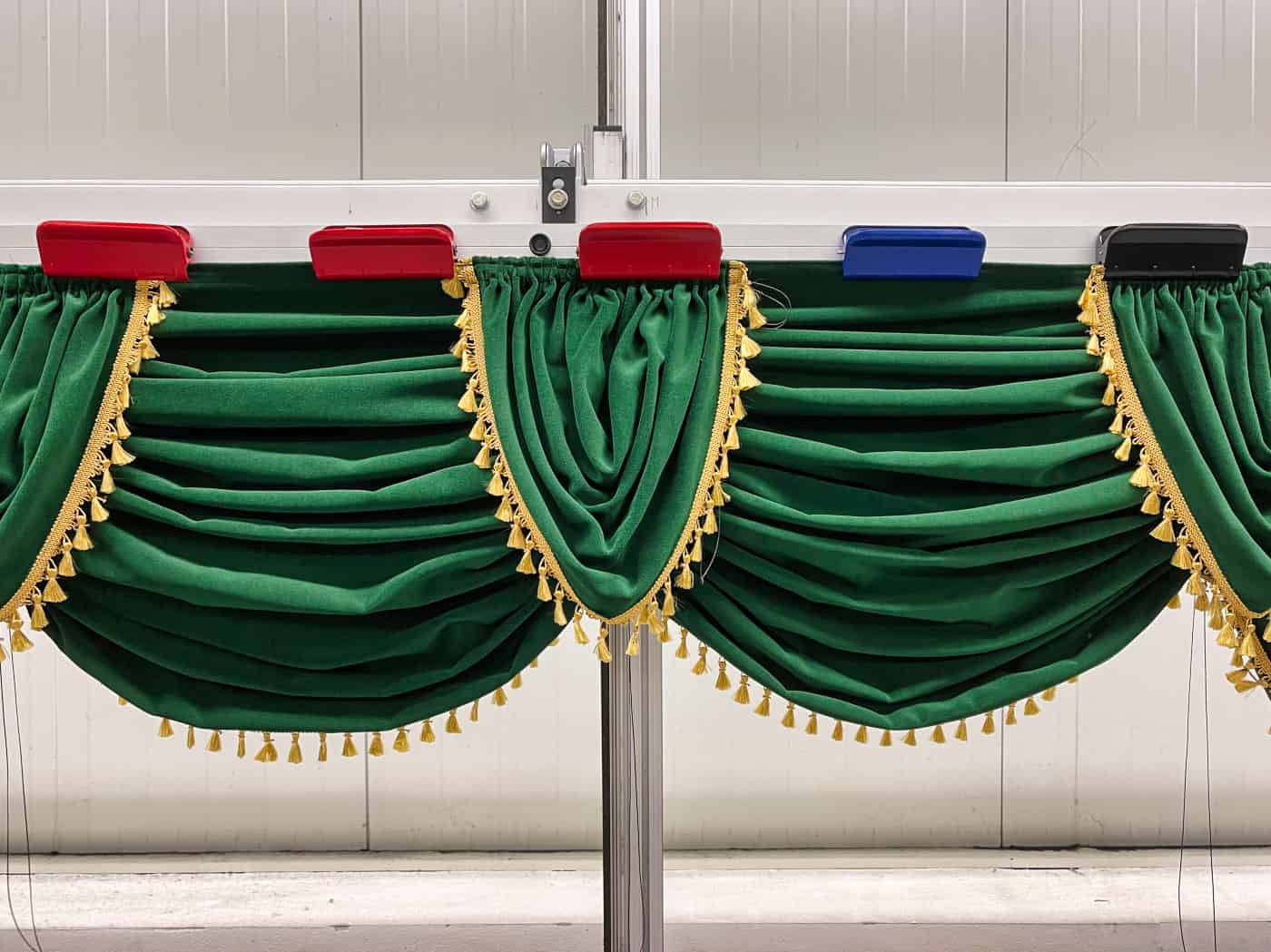
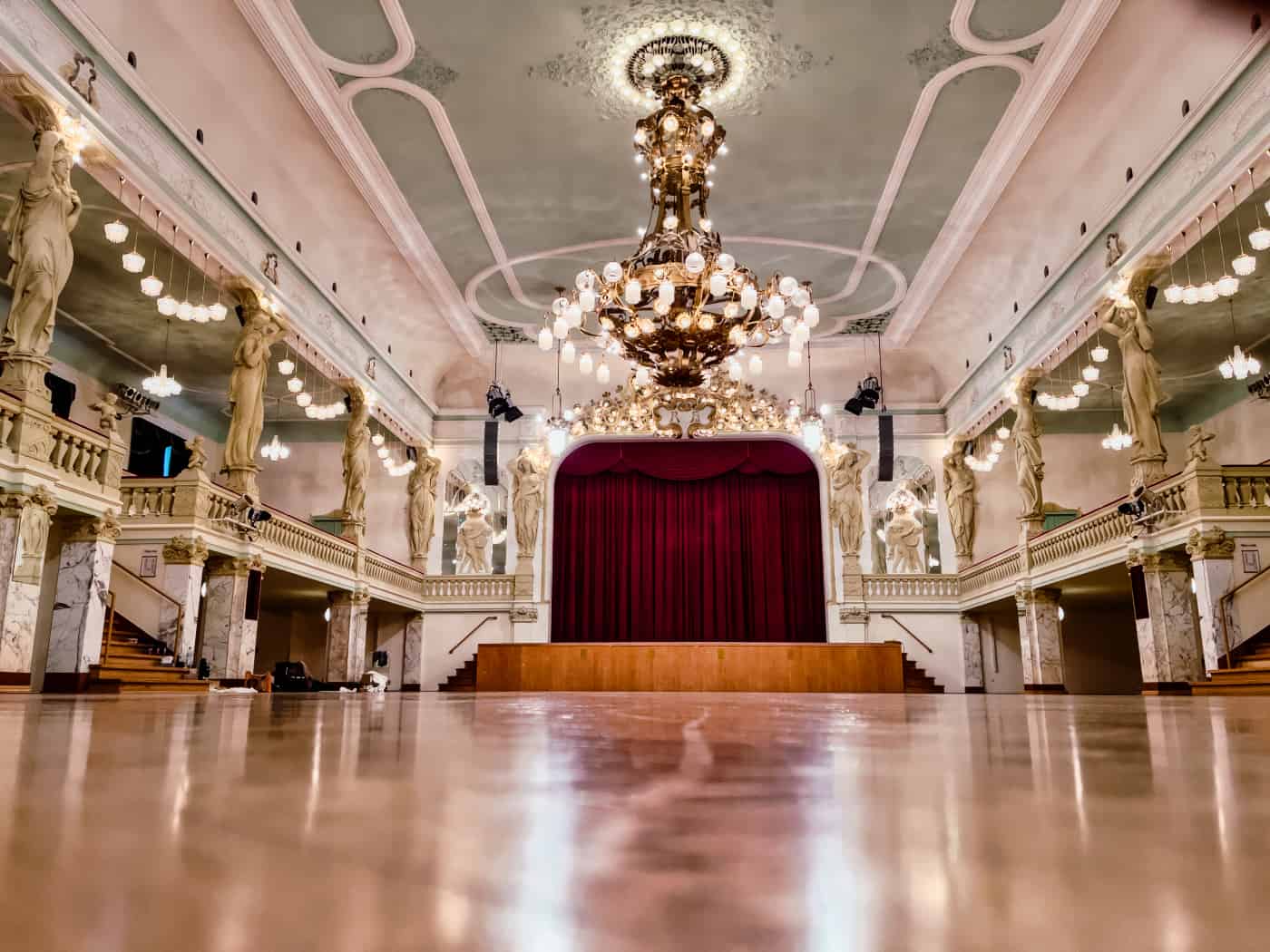
In 2019 Rabenring replaced the curtains of the Neue Welt concert and ballroom in Zwickau, Germany: a new house curtain, Art Nouveau window curtains with a curved velvet border, and new velvet cushions on the balustrades, all in the original colours. The team needed three weeks to make everything and three days to install it.




Frequently asked questions
What is the curtain in a theatre called?
The large curtain at the proscenium opening is the house curtain, also called the main curtain or front tabs. There are also legs at the sides, borders above, back drops and, on large stages, the safety curtain for fire protection.
Why are theatre curtains red?
Red was the colour of royalty and of performances at court. The tradition has lasted, although many theatres now choose other colours.
What is the difference between a traveller, tableau and fly curtain?
The names describe how the curtain opens. A traveller splits in the middle and is drawn to the sides. A tableau curtain is gathered up diagonally to the sides. A fly curtain rises straight up as one piece. A festoon curtain lifts and gathers at the same time.
What is a safety curtain?
A fire barrier of non combustible material that closes the proscenium opening on large stages. Under German rules it must close by its own weight within 30 seconds.
How much does a stage curtain weigh?
Weight follows from fabric area and fabric weight. For an opening 8 m wide and 6 m high with 100 % fullness you need around 96 m² of fabric. With stage velvet of about 520 g/m², the curtain already weighs around 50 kg, before lining, webbing and chain weight.
Which fire rating does a stage curtain need?
In Germany stage curtains must be at least flame retardant, usually proven to DIN 4102 B1 or EN 13501-1. Other countries have their own tests. Always ask for the test certificate of the fabric, because building control and the fire brigade will want to see it.
Your theatre curtain, made to measure
Rabenring, based near Dresden in Germany, makes flame retardant, sound absorbing theatre curtains to your size. Enquiries from outside Germany are welcome in English. Call us or write to info@rabenring.com.