
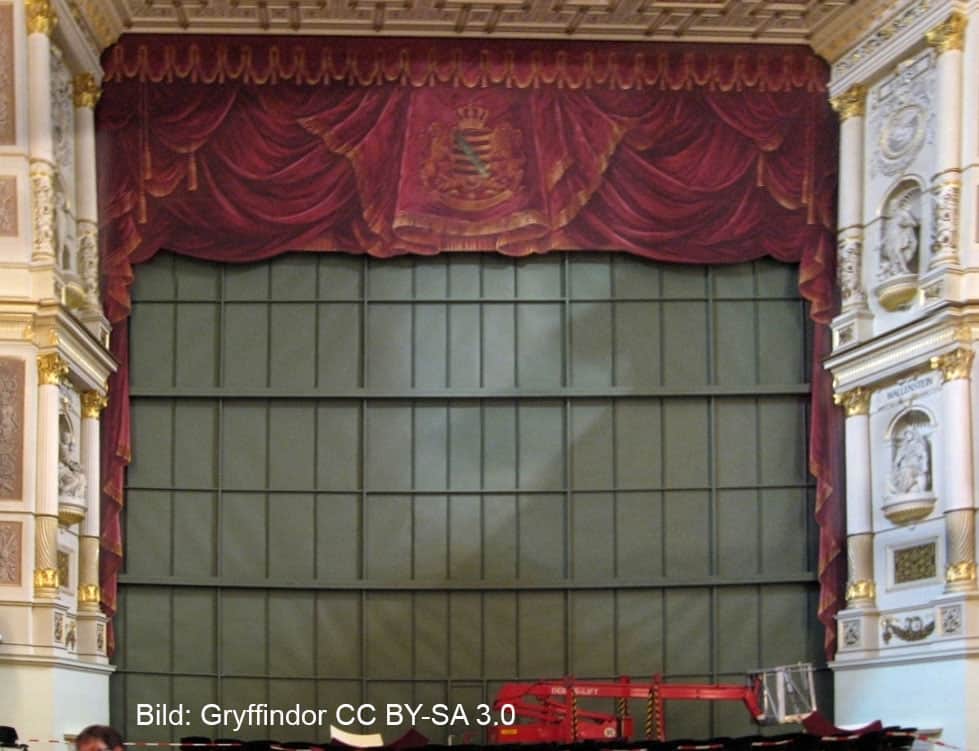
Arrive early at an opera house and you may not see red velvet at all, but a smooth, often painted wall across the stage. That is the safety curtain, still called the iron curtain in many theatres. It has little to do with looks. In a fire it separates the stage from the auditorium and buys the audience the minutes it needs to get out.
What is a safety curtain?
The safety curtain is a fire resistant barrier across the proscenium opening. German regulations call it the Schutzvorhang, the protective curtain. It sits right behind the proscenium arch and is lowered from above. When it is down, it meets fire resistant building parts on every side, and the stage house and the auditorium become two separate fire compartments.
The reason is obvious. Above and around a stage hang scenery, drops and curtains, plus lights, pyrotechnics and machinery in the fly tower and under the stage. If a fire starts there, heat and smoke must not reach the audience.
Which stages need one in Germany?
In Germany a safety curtain is required for large stages. The assembly building regulations of the federal states (Versammlungsstättenverordnung) count a stage as large if at least one of these applies:
- The acting area behind the proscenium opening is larger than 200 m².
- There is a fly tower with more than 2.50 m clear height above the opening.
- There is an understage.
Smaller stages in school halls, community centres or cabaret venues do not need one. Their curtains and scenery still have to meet fire safety requirements, more on that below. Other countries have their own building codes, so check the requirements with your local building control or fire authority.
What the German rules require
The rules are similar in all German states because they are based on the same model regulation. The Bavarian version (§ 23 VStättV, in German) requires, for example:
- The curtain is made of non combustible material and closes the opening tightly.
- It closes by its own weight, so it works without power.
- Closing takes no longer than 30 seconds.
- It withstands a pressure of 450 Pa in both directions.
- A warning signal sounds on stage while it comes down.
- A self closing door in the curtain, no more than 1 m wide, is allowed.
Which version applies to your building depends on the state. If in doubt, building control or a fire safety engineer will clarify the details.
The Ringtheater fire of 1881
On the evening of 8 December 1881 the Ringtheater in Vienna was sold out for the second performance of Offenbach’s Tales of Hoffmann. Shortly before curtain up, the scenery caught fire while the gas lights were being lit. The fire spread to the auditorium within minutes, the gas lighting in the house failed and the doors opened inwards. The official death toll was 386. People at the time believed the real number was much higher.
Austria reacted in 1882 and made, among other things, the iron curtain and flame retardant scenery compulsory. Over the following decades theatres across Europe were refitted. Many rules we now take for granted go back to that night: doors that open outwards, emergency lighting and flame retardant textiles on stage.
Safety curtain and house curtain: the difference
The safety curtain is fire protection. The theatre curtain in the narrower sense, the velvet house curtain, is part of the show. It opens at the start, closes for the interval and brings the cast back for the curtain call. In theatres with a large stage both hang one behind the other: the safety curtain on the audience side, the textile house curtain behind it.
The house curtain is covered by fire rules too. Curtains on stages and acting areas must be at least flame retardant, in Germany usually proven to DIN 4102 B1 or to the European standard EN 13501-1. That applies to small stages without a safety curtain as well. Which fabrics qualify and how they differ is explained in our guide to velvet stage curtains. How to keep the protection intact when cleaning is covered in cleaning theatre curtains.
Frequently asked questions
Is the iron curtain really made of iron?
The name dates from the 19th century, when these curtains were made of riveted iron sheets. Today they are usually a steel frame clad with sheet metal. What matters is that the material does not burn.
Why can I sometimes see the safety curtain before the show?
In many theatres it stays down until the audience is seated, or it is tested before every performance. Some houses have it painted by artists so that it becomes a picture in its own right.
What does the safety curtain have to do with the Cold War?
Nothing technical. The political term „Iron Curtain“ for the border between East and West was borrowed from the theatre: an impenetrable wall dividing two spaces.
More on the topic: Safety curtain on Wikipedia